
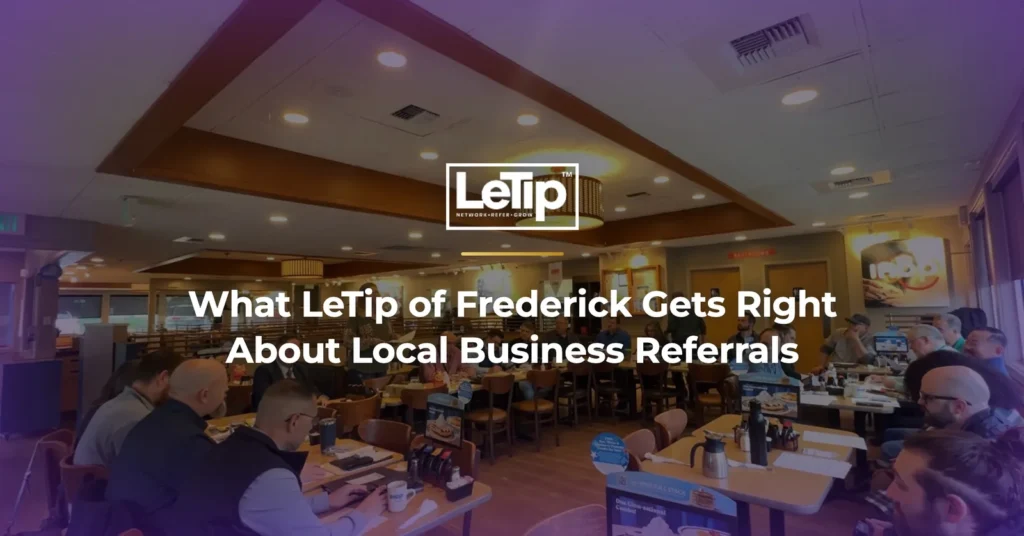
LeTip has run on the same three rules since 1978: one member per industry, three referrals a month, and a standing weekly meeting nobody is allowed to skip quietly. Almost half a century later, the Frederick, Maryland chapter still meets for breakfast every Wednesday morning and passes warm business to people sitting around the same table. In a year when most local marketing advice is about ad budgets and algorithms, a 7:15 a.m. coffee meeting is doing something the algorithms cannot.
We pay attention to LeTip of Frederick because we work with referral networks for a living, and this one gets the fundamentals right.
A 1978 idea that refused to age
LeTip was started in San Diego in 1978 by an insurance executive named Ken Peterson, and it is generally credited as the first structured business networking group in the United States. It incorporated in California in 1979 and grew into more than 250 chapters across the U.S. and Canada. Since the start, LeTip says its programs have helped more than 120,000 members grow through personal referrals.
The mechanics have barely changed because they did not need to. A LeTip chapter holds one seat per profession. The plumber is the only plumber. The commercial insurance agent is the only commercial insurance agent. Members are expected to bring three qualified referrals a month and to actually know each other well enough to vouch. That last part is the difference between a referral and a cold lead, and it is the part no ad platform can fake.
How LeTip of Frederick actually runs
The Frederick chapter meets weekly, early, in person. The standing meeting is Wednesday morning around 7:15 at the IHOP in Westview, with breakfast and a working agenda built around who needs what kind of customer this week. Members trade tips, report on referrals they passed, and hold each other to the three-a-month expectation. It is small-business owners doing the unglamorous work of learning one another’s businesses well enough to send a neighbor with confidence.
The category-exclusive structure is what keeps it honest. Because there is only one electrician, one realtor, one accountant in the room, nobody is hedging. When the chapter’s roofer hears that someone’s mother-in-law has a leak, there is exactly one person that referral goes to, and the room expects that person to take care of it. Reputation inside the group is the currency, and it spends slowly.
Why category exclusivity beats reach
Here is an opinion we will defend: a warm referral from someone who has watched you work closes faster, and at a higher rate, than almost any paid channel a small local business can buy. We run Google Ads and paid social for clients across Frederick County and the wider DMV, and those channels earn their place. But a Google click is a stranger at the top of a funnel. A LeTip tip is a name handed across a breakfast table by someone staking a little of their own credibility on the introduction.
Groups like LeTip and its better-known peer BNI both understand this, and both are built on the same insight: scarcity and accountability make referrals real. One seat per category means the referral has nowhere else to go. A weekly attendance expectation means the relationships are maintained, not assumed. The structure does the work that good intentions usually fail to do on their own.
What a single referral is worth to a Frederick business
Think about the math for a home-service company. A roofing or HVAC job in this market runs into the thousands. If one chapter member sends two real referrals a quarter and one of them books, the membership has paid for itself many times over before lunch. Compare that to a cost-per-lead on paid search, where you pay for every click whether or not the person was ever serious, and the value of a vouched introduction becomes obvious.
The catch is that referral networking only compounds if someone is tracking it. Most chapters and most members still run on memory, a paper slip, and a follow-up text that may or may not happen. The relationships are strong; the bookkeeping is weak. That gap is exactly the thing we have spent the last year building software to close.
Where this connects to what we build
We are a Frederick-area marketing and software studio, and referrals are not a side interest for us. We built ARGO, a referral platform for home-service companies, on the same principle LeTip proved decades ago: a referral is only as good as the trust behind it and the follow-up after it. The difference is that ARGO tracks every referral, every status change, and every payout so the warm introduction does not die in someone’s inbox. If a 7:15 breakfast is the relationship layer, software is the memory layer, and the two are stronger together.
If you want to see how we think about turning local relationships into measurable growth, our team page explains the studio, and you can always book a working session to map it against your own business.
If you run a business in Frederick
Go visit a LeTip of Frederick meeting before you decide anything. Show up to a Wednesday breakfast, watch how the referrals move, and see whether your category is still open. The worst case is a free breakfast and a few new contacts. The best case is a steady stream of vouched business that no ad account will ever replicate. For details on the chapter, the LeTip of Frederick Meetup page lists upcoming meetings, and LeTip International covers how the wider organization works.
[Image slot: photo of a LeTip of Frederick weekly breakfast meeting, or the LeTip of Frederick chapter logo. Alt text: “LeTip of Frederick business referral networking meeting.”]