
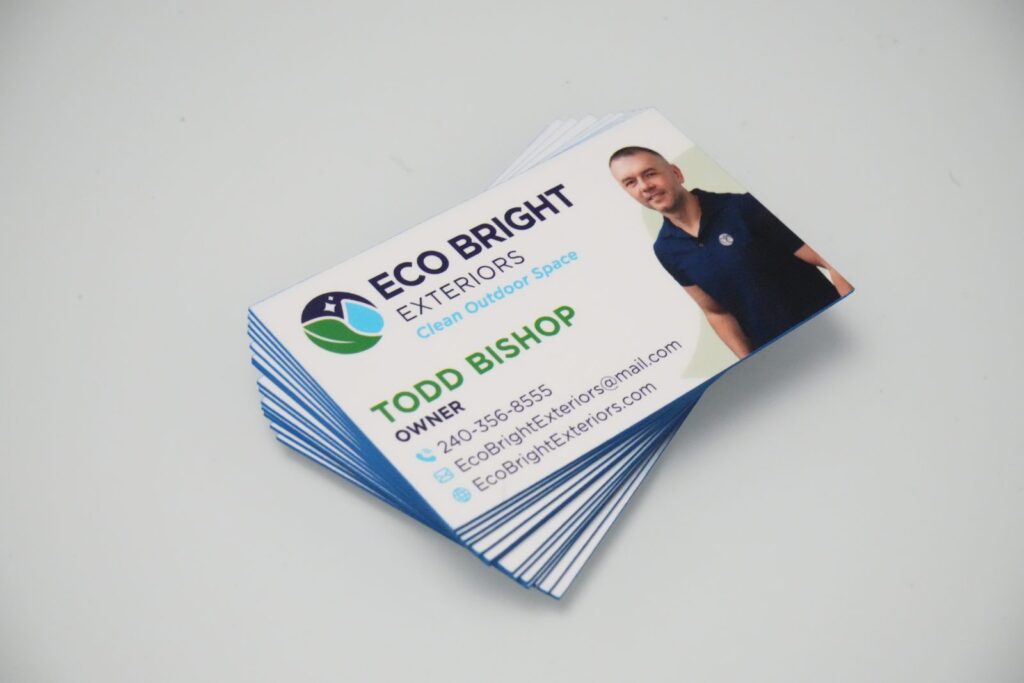
A business card wins work when it does three things well: it’s clean enough to read in two seconds, it feels substantial in the hand, and it tells the person exactly what to do next. The cards that get tossed are cluttered, flimsy, and vague. The cards that get kept are simple, printed on heavy stock (think 16pt to 32pt), and built around one clear call to action. You don’t need a fancy card to win work, but you do need a deliberate one, and good design and print run a market-typical $50 to $250 for a starter run.
Think about how this actually plays out around Frederick. A real estate agent hands a card across the table after a showing in Urbana. An auto shop owner slides one over the counter on Route 40. An electrician leaves one on the kitchen island after wrapping a panel job in Walkersville. In every case the card outlives the conversation. Days later, when the homeowner is ready to decide, the card is what’s left, and a thin, busy, forgettable one quietly loses you the job you already earned.
What Makes a Card Memorable
Memorable doesn’t mean loud. The most effective cards are usually the calmest ones on the table. Here’s what separates them:
- Simplicity above all. Name, what you do, one phone number, one way to reach you online. White space is not wasted space, it’s what makes the important stuff readable.
- Stock you can feel. A thick, rigid card signals a serious business before anyone reads a word. A flimsy one signals the opposite, no matter how good your logo is.
- A finish with intention. Matte reads as understated and professional. Gloss makes color pop. Soft-touch feels premium in the hand. Pick one that fits who you are, don’t just take the default.
- One clear call to action. “Call for a free estimate.” “Book online.” “Scan to see our work.” Tell people the next step instead of hoping they figure it out.
- Consistency with everything else. Your card, your van, your invoices, and your website should look like the same company. That coherence is what builds recognition, and it’s why we tie card design to a full brand identity system.
Stock and Finish: A Quick Reference
These are market estimates for planning, not fixed Ventanix prices, but they’ll help you decide where to spend.
| Option | Feel | Cost impact | Best for |
|---|---|---|---|
| 14–16pt matte | Standard, clean | Lowest | Everyday business, high volume |
| 16pt gloss | Bright, colorful | Low | Restaurants, retail, photo-driven brands |
| 18–32pt premium | Thick, substantial | Medium–High | Real estate, medical, professional services |
| Soft-touch / suede | Luxe, velvety | Higher | Salons, designers, premium brands |
| Spot UV or foil | Eye-catching accents | Highest | Standing out, high-touch first impressions |
The honest take: most Frederick businesses do great with a clean 16pt matte. Premium finishes pay off when the first impression is part of what you’re selling.
Common Mistakes That Cost You Jobs
Most bad cards fail in predictable ways. Avoid these and you’re ahead of most of your competition:
- Cramming in everything. Three phone numbers, two emails, a fax line, four social icons, and a paragraph about your mission. Pick what matters and cut the rest.
- Tiny, unreadable type. If a 55-year-old homeowner can’t read your number without squinting, the card failed at its one job.
- Going too cheap on stock. A flimsy card undercuts every other dollar you spend on marketing. People judge quality by touch.
- No call to action. A card that just lists facts leaves the next step to chance. Tell them what to do.
- Dead QR codes or wrong numbers. Always proof against reality. A typo on a card you ordered 1,000 of is an expensive lesson.
- Trendy over timeless. A card you’ll reprint in six months because it already looks dated wasn’t a good deal at any price.
When Premium Finishes Actually Pay Off
You don’t always need the fancy stuff. Sometimes you do. Here’s the honest line.
Premium finishes earn their cost when the card itself is part of your pitch. A real estate agent competing for a listing, a salon selling an experience, a med spa, a designer, a high-end remodeler, these are businesses where the card’s weight and feel quietly reinforce “we’re worth it.” In those cases, soft-touch stock, spot UV, or foil isn’t vanity, it’s positioning.
Premium finishes are usually overkill when volume and cost matter more than feel. If you’re an HVAC company handing out hundreds of cards a month, or a restaurant leaving them by the register, a sharp 16pt matte does the job and your budget goes further. Spend the difference on more cards in more hands.
Which Is Right for You
- Choose standard matte if you hand out a lot of cards, compete mostly on service and price, and need every dollar working. Most trades and everyday businesses live here.
- Choose gloss if your work is visual, food, retail, anything photo-driven, and you want color to pop on the card.
- Choose premium stock or finishes if your first impression is part of your value, your clients expect polish, and you hand out fewer cards to higher-value prospects.
When in doubt, upgrade the stock before you upgrade the finish. Thickness is felt by everyone, every time. Fancy finishes are a bonus on top.
Keep reading
promotional products that get used · print versus digital marketing
Let’s Make a Card That Earns Its Keep
A great business card is a small thing that quietly closes business for you long after you’ve left the room. We help Frederick businesses design cards that look right, feel right, and tell people exactly what to do next.
Ventanix handles design and print from our office at 5740 Industry Lane, Suite B in Frederick. See our print and promotional services, then book a free strategy session or call (240) 253-1233. Let’s make a card worth keeping.