
It’s the question almost every client asks when we set up a paid social campaign: Should leads go to a Facebook lead form or to a landing page on our website? The honest answer is “it depends” — but that’s not an excuse to flip a coin. Here’s how to actually decide, and why the best answer is usually not one or the other.
What a Meta Lead Form does well
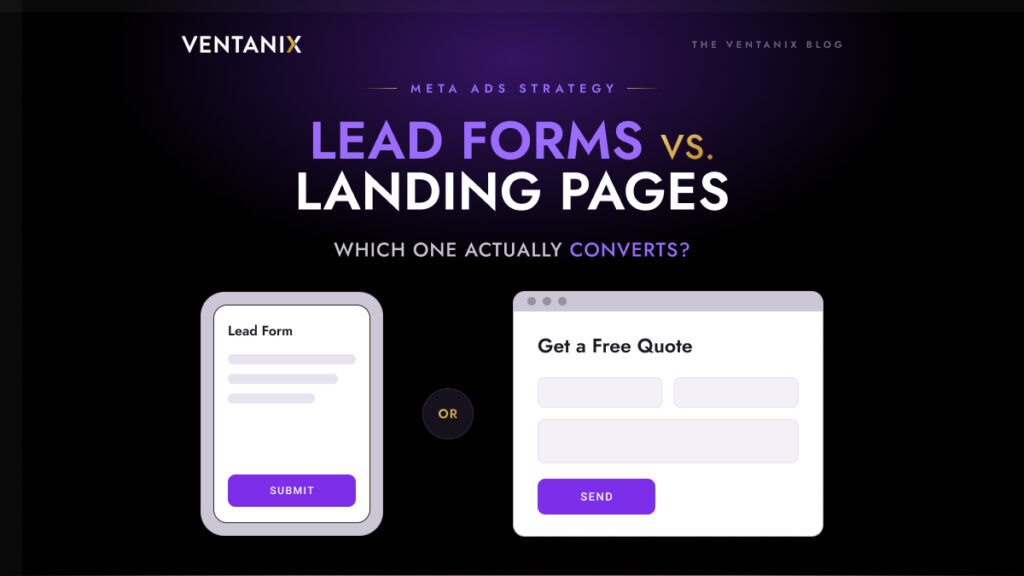
A Meta Lead Form (Facebook and Instagram’s “instant form”) opens right inside the app and pre-fills the user’s name and contact info. There’s no click-out, no page to load, no friction. Because of that, lead forms typically convert at a higher rate and a lower cost per lead.
The catch is intent. A form that’s easy to tap through gets filled out by people who are only mildly curious. You’ll get more leads, but a chunk of them will be tire-kickers.
What a landing page does well
A landing page lives on your website. The extra click and load step cost you some volume and push your cost per lead up. In exchange, the people who fill it out are more committed — they took an extra step to get there. You also own the experience: you control the page, you collect richer pixel data, and you can retarget visitors who didn’t convert. It’s a durable asset, not just a form.
Volume vs. quality, side by side
| Meta Lead Form | Landing Page | |
|---|---|---|
| Conversion rate | Higher | Lower |
| Cost per lead | Lower | Higher |
| Lead quality / intent | Lower | Higher |
| Data & retargeting | Limited | Strong |
| Build effort | Minimal | More |
Neither column is “the winner.” They’re two different trades between getting more leads and getting better ones.
How to protect lead-form quality
If you go the lead-form route, you don’t have to accept low intent. A few moves tighten things up: add one or two qualifying questions (Are you the homeowner? How old is your system?), write a higher-intent intro so casual tappers self-select out, and follow up instantly while interest is hot. A qualified lead form can perform beautifully.
The phased mix — the real recommendation
For most local businesses on a modest budget, the smartest approach isn’t to choose. It’s to sequence:
- Launch on a lead form. It’s fast, cheap, and fills your pipeline immediately while feeding your tracking the conversion data it needs to optimize.
- Build the landing page in parallel. Stand up your higher-intent, retargetable asset while the form does the early work.
- Then A/B test the two and let real cost-per-lead and close-rate numbers decide where the budget goes.
One caution: don’t split a small budget 50/50 from day one. That starves both of the data they need to learn. Start with the form, add the page, then test.
Bottom line
Lead forms give you speed and volume today. Landing pages give you quality and a durable, retargetable asset. Run the form first, build the page alongside it, and let your own numbers settle the debate. That’s how you stop guessing and start optimizing.
This decision is one piece of a bigger picture — see our full guide to paid social for home-service businesses.
Not sure which fits your business? Ventanix will map it to your budget and sales process. Talk to us.